Let me C : Functions and Preprocessor
Here I will introduce ideas like scope, separate compilation, and the preprocessor.
Basic Structure of function:
1
2
3
4
5
return-type function-name(parameter declarations)
{
    declarations
    statements
}
Functions returning non-integers
If a function is used before its definition or declaration appears, and nothing tells the compiler otherwise, C (in the old K&R style) assumed it returned int. If your function actually returns a double, that assumption silently produces garbage - the bit pattern of a double gets misinterpreted as an int.
Fix:
1
2
3
4
5
6
7
8
9
10
11
12
13
14
15
#include <stdio.h>

double average(double a, double b);   // <-- prototype: promise of what's to come

int main(void)
{
    double result = average(4.0, 7.0);
    printf("Average: %.2f\n", result);
    return 0;
}

double average(double a, double b)    // <-- actual definition
{
    return (a + b) / 2;
}
External Variables
1
2
3
4
5
6
7
8
9
10
11
12
13
14
15
16
17
18
19
20
21
22
#include <stdio.h>

int counter = 0;   // external variable — declared outside any function

void increment(void)
{
    counter++;      // no need to pass counter in — it's visible here
}

void print_counter(void)
{
    printf("Counter is: %d\n", counter);
}

int main(void)
{
    increment();
    increment();
    increment();
    print_counter();   // prints "Counter is: 3"
    return 0;
}
Now lets look at another example here:
1
2
3
4
5
6
7
8
9
10
11
12
13
14
int count = 10;   // external variable, count = 10, visible file-wide

void reset(void)
{
    int count = 0;   // LOCAL variable — shadows the external one!
    printf("Inside reset: count = %d\n", count);  // uses the LOCAL count
}

int main(void)
{
    reset();
    printf("Inside main: count = %d\n", count);   // uses the EXTERNAL count
    return 0;
}
Shadowing: Inside reset(), the line int count = 0; creates a brand-new local variable that happens to share the same name as the external one. C’s scoping rule is: the innermost declaration wins. So inside reset(), every reference to count refers to the local count = 0 - the external count is temporarily “shadowed” and completely inaccessible from within that function.
Once reset() returns, that local count is destroyed - it never touched the external count at all. So back in main(), count still refers to the external variable, untouched at 10.
Scope Rules
Automatic Variables
1
2
3
4
5
6
7
8
9
10
int main(void)
{
    int x = 5;         // automatic — scope: within main's braces only
    if (x > 0) {
        int y = 10;     // automatic — scope: within the if-block ONLY
        printf("%d\n", y);
    }
    // y is NOT visible here — it's out of scope
    return 0;
}
External Variables
1
2
3
4
5
6
7
int main(void)
{
    // x is NOT visible here yet!
    return 0;
}

int x = 100;   // x's scope begins HERE, extends to end of file
extern
1
2
3
4
5
6
7
/* helper.c */
int total = 0;

void add_to_total(int n)
{
    total += n;
}
1
2
3
4
5
6
7
8
9
10
11
12
#include <stdio.h>

extern int total;              // declares the variable defined in helper.c
void add_to_total(int n);      // prototype for the function in helper.c

int main(void)
{
    add_to_total(5);
    add_to_total(10);
    printf("Total: %d\n", total);   // prints "Total: 15"
    return 0;
}
Key Concept
- Block scope is strict in C — unlike Python, a variable declared inside an if or for block is genuinely invisible outside it. Braces wall things off.
- Top-to-bottom visibility — an external variable’s scope starts at its declaration line, not automatically from the top of the file. Using it earlier fails to compile.
- extern solves the ordering/multi-file problem — it’s a declaration (announces type, no storage allocated), not a definition (which actually allocates memory and happens exactly once). This lets you:
1
2
* Use a variable in main() before its real definition appears later in the file.
* Share a variable across multiple .c files — defined once in one file, declared extern wherever else it's needed.
- Shadowing — a local variable can share a name with an external one; inside that block, the local one wins and the external one is temporarily hidden.
Header Files
A header file (.h) collects related declarations - extern variables, function prototypes, macros, type definitions - in one place. Any .c file that needs them just does #include "yourheader.h", and the preprocessor literally pastes that file’s contents in at that point, before real compilation even begins.
Python analogy: This is loosely like import mymodule - except C’s #include is far more primitive. It’s not a smart module system; it’s literally a textual copy-paste performed by the preprocessor. There’s no namespacing, no “module object” - just raw text substitution
1
2
3
/* helper.h */
extern int total;              // declaration, not definition
void add_to_total(int n);      // prototype
1
2
3
4
5
6
7
8
9
/* helper.c */
#include "helper.h"    // pulls in declarations for consistency-checking

int total = 0;         // the one true DEFINITION

void add_to_total(int n)
{
    total += n;
}
1
2
3
4
5
6
7
8
9
10
11
/* main.c */
#include <stdio.h>
#include "helper.h"    // same declarations, now shared/reused

int main(void)
{
    add_to_total(5);
    add_to_total(10);
    printf("Total: %d\n", total);
    return 0;
}
Static Variables
- static on a variable inside a function - persistence across calls.
1
2
3
4
5
6
7
8
9
10
11
12
13
14
15
16
 #include <stdio.h>

 void counter(void)
 {
     static int calls = 0;   // initialized ONCE, ever
     calls++;
     printf("Called %d times\n", calls);
 }

 int main(void)
 {
     counter();   // "Called 1 times"
     counter();   // "Called 2 times"
     counter();   // "Called 3 times"
     return 0;
 }
Normally, automatic (local) variables are destroyed when the function returns and recreated fresh next time.
staticchanges that: the variable is initialized once, and then retains its value between function calls - while still only being visible inside that function (scope unchanged). - static on an external variable or function - restricting visibility to one file.
1
2
3
4
5
6
7
 /* helper.c */
 static int secret = 42;   // ONLY visible within helper.c

 static void internal_helper(void)   // ONLY callable within helper.c
 {
     // ...
 }
Here
staticmeans something almost opposite: instead of persistence, it’s about hiding something from other files. Normally, external variables/functions are visible to any file thatextern-declares them. Marking onestaticat file scope makes it private to that.cfile only — no other file can link to it, even withextern.
Register Variables
register is a storage class, just like static and extern, but its purpose is different: it’s a hint to the compiler that a variable will be used very heavily (e.g., a loop counter accessed thousands of times), so it should - if possible - be kept in a CPU register instead of regular memory, for faster access.
1
2
3
4
5
6
7
8
9
10
int sum_squares(int n)
{
    register int i;      // hint: keep 'i' in a fast CPU register
    int total = 0;

    for (i = 1; i <= n; i++) {
        total += i * i;
    }
    return total;
}
Only automatic variables (and function parameters) can be declared register - it makes no sense for external/static variables, since those need a fixed, addressable memory location anyway.
register is considered largely a historical/legacy keyword in modern C
Block Structure
1
2
3
4
5
6
7
8
9
10
11
12
13
14
#include <stdio.h>

int main(void)
{
    int x = 1;                 // outer block: x = 1

    if (x > 0) {
        int x = 2;              // inner block: NEW x, shadows outer x
        printf("Inner x = %d\n", x);   // prints 2
    }

    printf("Outer x = %d\n", x);       // prints 1 - untouched!
    return 0;
}
C does not allow nested function definitions
The inner x is a completely separate variable from the outer x - same name, different storage, different scope. Once the if block ends, the inner x is gone, and x reverts to referring to the outer one, exactly as if the inner block never happened.
Initialization
- Rule 1: External and static variables default to zero
1
2
  int global_count;         // external, no initializer -> automatically 0
  static int cache_size;    // static, no initializer -> automatically 0
This happens because external/static storage is set up once, before main() even runs, and the C runtime guarantees that memory starts zeroed out.
- Rule 2: Automatic and register variables have NO default value - they contain garbage.
1
2
3
4
5
  void demo(void)
  {
      int x;              // automatic, uninitialized -> UNDEFINED, garbage value
      printf("%d\n", x);   // could print anything - reads whatever bits were left in memory
  }
Automatic storage is just reused stack memory from whatever ran before - the compiler makes zero promises about its contents.
C’s silent “zero for globals, garbage for locals” behavior is a common source of bugs for people coming from higher-level languages, so it’s worth internalizing this rule carefully.
Recursion
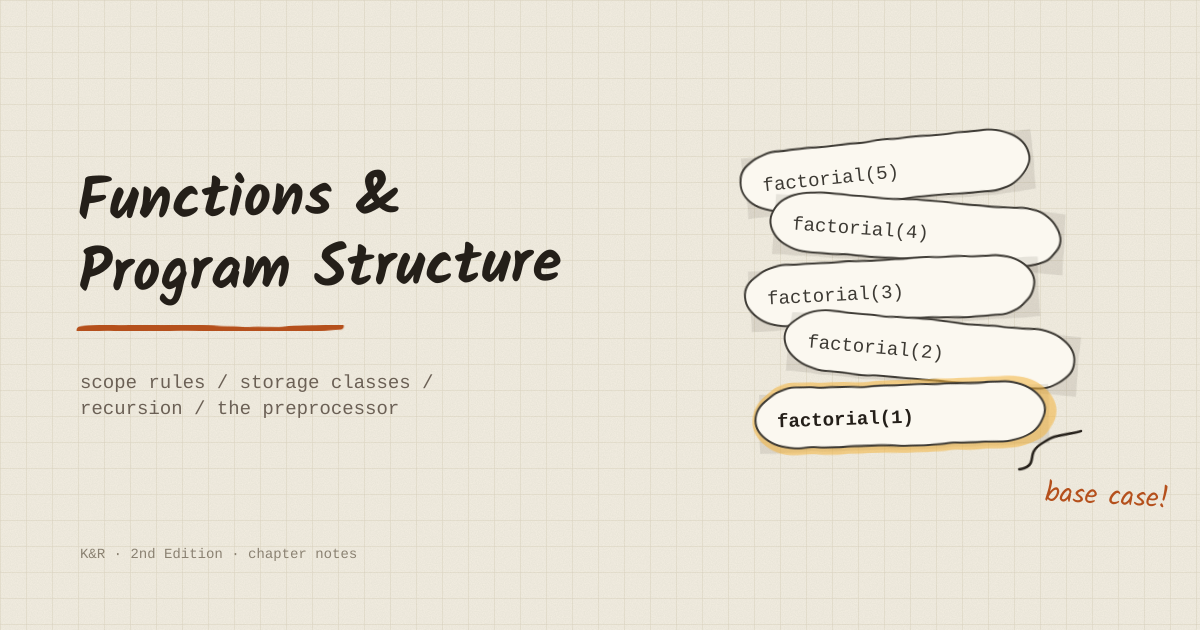
Recursion is a function solving a problem by calling itself on a smaller version of the same problem, until it hits a base case simple enough to answer directly without recursing further.
1
2
3
4
5
6
7
8
9
10
11
12
13
14
15
#include <stdio.h>

int factorial(int n)
{
    if (n <= 1) {          // base case: stops the recursion
        return 1;
    }
    return n * factorial(n - 1);   // recursive case: smaller subproblem
}

int main(void)
{
    printf("5! = %d\n", factorial(5));
    return 0;
}
Let’s trace it mentally:
1
2
3
4
5
factorial(5) = 5 * factorial(4)
factorial(4) = 4 * factorial(3)
factorial(3) = 3 * factorial(2)
factorial(2) = 2 * factorial(1)
factorial(1) = 1              <- base case reached, unwinding begins
Each call is suspended, waiting on the result of the next, until factorial(1) returns 1, and then the multiplications happen in reverse order as the stack unwinds: 1 -> 2*1=2 -> 3*2=6 -> 4*6=24 -> 5*24=120.
The C Preprocessor
File Inclusion
1
2
3
4
5
6
7
8
#include <stdio.h>   // preprocessor pastes in the full contents of stdio.h here
#include "helper.h"  // preprocessor pastes in the full contents of helper.h here

int main(void)
{
    printf("Hello\n");   // printf's prototype came from that pasted-in stdio.h
    return 0;
}
Macro Substitution
1
#define name replacement text
Another preprocessor directive, #define, lets you give a name to a piece of text, and the preprocessor will substitute that text in, wherever the name appears, before compilation even starts. This is purely textual - no type-checking, no evaluation - just find-and-replace.
1
2
3
4
5
6
7
#define MAX_SIZE 100

int main(void)
{
    int arr[MAX_SIZE];   // preprocessor replaces this with: int arr[100];
    return 0;
}
Important Concept
1
#define getchar() getc(stdin)
In many implementations of <stdio.h>, getchar() and putchar() aren’t actually plain functions - they’re defined as macros, for performance reasons (avoiding function-call overhead for something used so heavily, character by character).
1
2
3
4
5
6
#undef getchar   // remove the macro definition

int getchar(void)   // now this refers to the REAL underlying function
{
    // ...
}
#undef is the escape hatch. It tells the preprocessor: “forget that macro definition from this point forward in the file.”
Conditional Inclusion
Just like your program has if/else for runtime decisions, the preprocessor has its own parallel set of directives for compile-time decisions: #if, #ifdef, #ifndef, #else, #elif, and #endif. These decide which chunks of source code even reach the compiler, based on conditions evaluated during preprocessing.
- Example 1:
#ifdef/#ifndef- “Is this name defined?”1 2 3 4 5 6 7 8 9 10
#define DEBUG int main(void) { #ifdef DEBUG printf("Debug mode is on\n"); // only included if DEBUG is #defined #endif printf("Program running\n"); return 0; }
Here’s the key: the preprocessor scans the file first, sees
#ifdef DEBUG, checks “hasDEBUGbeen#definedanywhere above this point?” - yes - so it keeps thatprintfline as-is. Then it hands off a modified source file to the actual compiler, which looks like this:1 2 3 4 5 6
int main(void) { printf("Debug mode is on\n"); printf("Program running\n"); return 0; }
The
#ifdefand#endiflines are gone entirely - they were never real C code, just instructions to the preprocessor.Now, if you delete
#define DEBUGfrom the top of the file, the preprocessor’s check fails (“DEBUGis NOT defined”), so it deletes that entireprintfline before the compiler ever sees it. The compiler receives:1 2 3 4 5
int main(void) { printf("Program running\n"); return 0; }
- Example 2:
#ifndefand#defineguard1 2 3
/* helper.h */ extern int total; void add_to_total(int n);
1
2
 /* other.h */
 #include "helper.h"   // other.h needs helper.h's declarations too
1
2
3
 /* main.c */
 #include "helper.h"   // included directly...
 #include "other.h"    // ...but other.h ALSO includes helper.h internally!
Remember:
#includeis just copy-paste. So when the preprocessor flattensmain.c, it pastes inhelper.h’s contents once directly, and again indirectly throughother.h. The compiler ends up seeingextern int total;andvoid add_to_total(int n);twice - which causes duplicate-declaration errors.Now let’s trace the guard.
1
2
3
4
5
 #ifndef HELPER_H
 #define HELPER_H
 extern int total;
 void add_to_total(int n);
 #endif
First time helper.h gets pasted in (via main.c’s first #include):
#ifndef HELPER_H- preprocessor asks: “has the nameHELPER_Hbeen#defined anywhere yet?” Answer: no, this is the very first time. So it proceeds into the block.#define HELPER_H- this immediately marksHELPER_Has now defined (it doesn’t need a value, it’s just a flag/marker, same idea asDEBUGfrom before).- The two declaration lines get pasted in normally.
#endifcloses the conditional.
Second time
helper.hgets pasted in (viaother.h’s#include, later in the same file):#ifndef HELPER_H- preprocessor asks the same question again: “hasHELPER_Hbeen defined yet?” This time, the answer is yes - step 2 above already defined it, earlier in this same preprocessing pass.- Since the condition (
ifndef= “if not defined”) is now false, the preprocessor skips straight past everything down to#endif- the two declaration lines are not pasted in a second time.
End result: no matter how many places
#include "helper.h"(directly or indirectly), the actual declarations only get pasted into the final flattened source once - Example 3 :
#ifwith actual conditions (not just defined -checks)1 2 3 4 5 6 7
#define VERSION 2 #if VERSION >= 2 printf("Using new feature\n"); #else printf("Using legacy behavior\n"); #endif